
Justin Elford
Director of Manufacturing
Justin Elford, Director of Manufacturing, provides an update on Quantum Design's recent investments in Quantum Design Oxford's manufacturing facilities at Tubney Woods, UK; the work to reconfigure our magnet line; how we're streamlining processes to increase throughput and efficiency; and what this means for on time delivery and customer experience.
Our magnet technology provides researchers with tools that routinely produce fields up to 14 Tesla in our dry Cryofree® products, and up to 20 Tesla in our wet (liquid helium cooled) products where required, with hundreds of systems running reliably in laboratories across the world (read our recent blog with Dr Andy Twin to find out more about our magnet capabilities and development). Superconducting magnets are in the founding DNA of Quantum Design Oxford, and we understand the need for continuous improvement and investment as magnet technology and applications evolve. That commitment is reinforced by Quantum Design's progressive and dedicated vision of customer service excellence.
Streamlining our superconducting magnet manufacturing line has been a very significant part of our ongoing work to reconfigure our UK factory for growth and to continuously improve our manufacturing processes to deliver excellence to our customers. I first wrote about our factory reconfiguration programme in 2023. This next phase – with the added investment by Quantum Design since its acquisition of Quantum Design Oxford in January 2026 – is focused on maximising process uptime, creating a streamlined end‑to‑end process, and making delivery predictable, all while maintaining the performance and quality our customers depend on.
In this blog, I run through the updates, how these changes are improving the way we work and deliver reliable systems for our customers, and what the next 18 months hold for our team and manufacturing capabilities.
The magnet manufacturing stream is now well over halfway through its transformation, with several key infrastructure improvements already in place.
Skills development, operating procedures and equipment have all been key areas for investment as we work towards a more flexible line that delivers across the different magnet types that our customers value.
Our coil winding room has been reconfigured to create more space for machinery, ready for the expansion plans of the line. Existing machines will be upgraded and complimented by new machinery to enable increased output by an additional 15% and maintain our range of magnets that we supply worldwide.
Three new, smaller‑footprint reaction ovens have been installed, combining the previous two‑step air‑burn and reaction process into a single, automated furnace cycle that controls gas, temperature and environment in one program.
This means we can run more batches to improve throughput, whilst retaining our large capacity ovens for our highest field magnets.
A new niobium tin (Nb3Sn superconductors) termination room has been built to expand capacity for growth in termination and reaction activities.
With the first phase now complete, we will continue to invest in winding machinery to match demand with the latest equipment available.
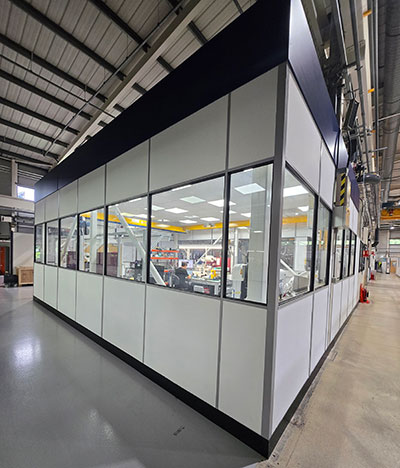
The new Tin Termination room
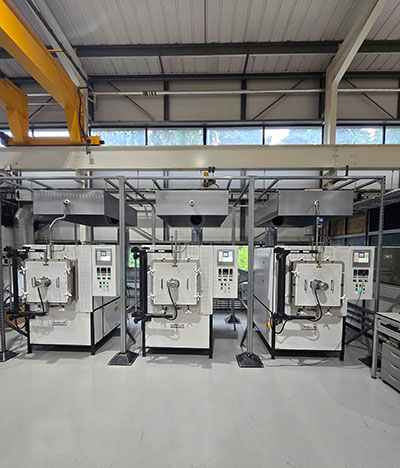
The three new installed furnaces
The magnet production line is supported by a dedicated team of over 20 Manufacturing Technicians, Manufacturing Engineers and Technical Engineers. With the support and investment of Quantum Design, we are currently expanding our magnet team to increase capacity with additional technicians and Manufacturing Engineers to support all states of magnet assembly. As part of the cross training, our magnet engineering team has been working with our technicians on upskilling to prepare for the next R&D initiatives. In conjunction with Magnet Engineers, our technician team has been closely undergoing a cross-training programme, allowing us to focus on upskilling to prepare for the next R&D activities.
We've introduced automation where it delivers the most impact and allows for 24/7 operation where needed, further optimising the efficiency of the factory.
Our engineers have also developed automated test scripts that allow magnets to be tested continuously once they are cold enough, shortening test timeframes and improving data capture. In addition, we have replaced our old measurement instruments and loggers, which, when combined with the automated test capability, gives a rich data set of magnet performance and capability, allowing us to stay on the cutting edge of magnet technology.
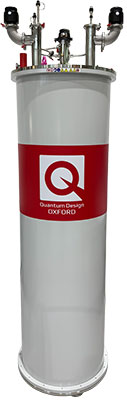
A clear example of the impact these changes are already having is a 20 Tesla at 4.2 Kelvin magnet system delivered to a customer in Japan. The magnet passed both its qualification and systemised tests first time, enabling delivery seven months ahead of its two-year lead time – an outstanding achievement and a testament to the recent design and manufacturing improvements on this 20 T magnet.
Despite its high magnetic field, the 20 T magnet system weighs ~650 kg (1,400 lb), standing 2.4 m (95") tall, with a compact diameter of only 64 cm (25.2"). A significant undertaking, that very few businesses in the world can execute reliably and on time.
The full magnet line transformation is on track to be completed over the next 18 months, including winding machine upgrades, potting rig equipment, and a new magnet test lab.
The end goal of the magnet value stream is to create a "factory within a factory" with dedicated end‑to‑end sub‑lines for different magnet types, including:
This segmentation allows the right resources and equipment to be focused on each type of magnet. Common magnets are being manufactured to forecast and held ready to ship, giving the factory greater flexibility and resilience. It also gives large, one‑off magnet builds their own manufacturing stream independent from the main flow, enabling all three magnet types to be manufactured in parallel.
The transformation we have made so far has been delivered whilst maintaining volume output, and minimising customer impact. Continuing to serve our customers without interruption is a clear principle behind our change program.
Our range of superconducting magnets continues to develop to support the applications and experiments our customers require, as we build on the exciting opportunities within the Quantum Design business. The intent of making high‑field magnet delivery more predictable and repeatable is no longer a distant prospect – implementing new manufacturing technologies and processes to underpin the range and reliability of Quantum Design Oxford's products for the future is happening today.
If you'd like to learn more about our magnet technologies, speak to a member of the team here.
If you'd like to learn more about our magnet technologies, speak to a member of our team:
Contact UsCopyright © 2026 Quantum Design Oxford