
Dr Andy Twin
Technology Development Manager
at Quantum Design Oxford
Dr Andy Twin, Technology Development Manager at Quantum Design Oxford, provides an overview of the innovation Quantum Design is doing in superconducting, high-field magnets, both within the team and through industrial collaboration.
Building on our recent blog describing Quantum Design Oxford's unique and powerful Cryofree® magnet technologies, let's introduce more details and some of the expert magnet team who make our solenoid, split pair and vector magnets an everyday reality for all our customers – world-class technology is built on world-class people. Beyond our standard magnets – which includes our helium-cooled 20 Tesla Integra magnet system – the Quantum Design Oxford team is currently collaborating with the National High Magnetic Field Laboratory (National MagLab) at Florida State University for an exciting new chapter in Quantum Design's magnet story.
At Quantum Design, we build our magnets to be reliable and predictable for our customers. Our magnets run in an optimised envelope, using low energisation currents whilst being extremely compact with low stored energies.
Our high-field Nb3Sn coil technology continues to provide researchers with tools that routinely produce 20 Tesla fields. Hundreds of our superconducting magnets have been running reliably up to 20 T for more than 20 years in leading research laboratories across the world – our magnets are an assured long-term investment to support our customers' present and future research capabilities.
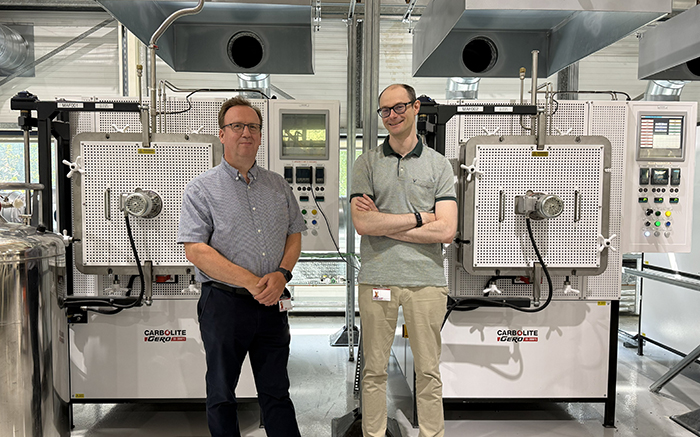
Dr Andy Twin (left) and Dr Ben Bryant (right)
In March 2026, Quantum Design Oxford signed a new strategic partnership with the National MagLab to realise the potential of their high temperature superconductor (HTS) technology. This collaboration combines the MagLab's high-pressure reaction and wire handling for Bi-2212 superconductors with the engineering experience of the Quantum Design Oxford team.
By merging the academic and industrial perspectives, we are ensuring that HTS technology is fully production ready. Between them, the teams have been building an ever-stronger suite of HTS coil technology utilising the specialised, hyperbaric oxygen furnaces in Florida. Our goal is to extend Quantum Design's standard product range, increasing magnetic field to above the 20 T available today.
Behind every high-field magnet system is a development team who view their work not only as solving engineering challenges, but as a partnership with the researchers who use these tools. We are committed to designing magnets to meet users' daily needs: reliable, stable, and "precision ramp" magnetic fields.
Expert Technologist Dr Andrew Varney's team specialises in quench modelling. Andrew has over three decades' experience in high-field and high-resolution superconducting magnets, in world-leading companies. His team develops computer codes that simulate the "quench" transition from a superconducting to a resistive state – central to ensuring the stability and reliability of magnets like the 20 T Integra. An Integra 20 Tesla magnet with a Kelvinox® dilution refrigerator is being used by Professor Isabel Guillamón and the team at the Universidad Autónoma de Madrid (UAM), Spain to study electronic conduction at the atomic scale. This is just one example of world-leading work being done using our high-field Integra systems.
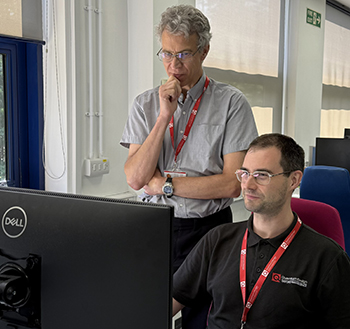
Dr Andrew Varney (left) and Steven Ball (right)
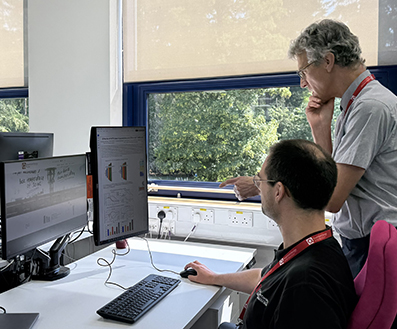
Dr Andrew Varney (left) and Steven Ball (right)
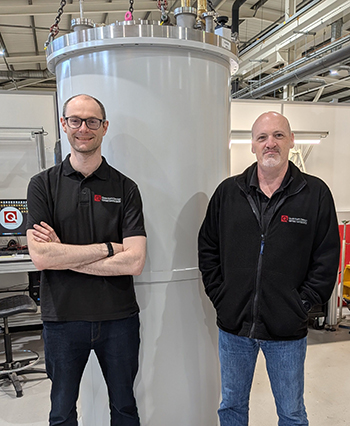
Dr Ben Bryant (left) and David Warren (right)
Dr Ben Bryant, a Senior Development Engineer who joined the team in 2019, leads the technical engineering program on Bi-2212 coil technology that will deploy across the Integra and Cryofree product ranges. Ben joined Quantum Design Oxford from a Research Fellowship at the High Field Magnet Laboratory in Nijmegen, Netherlands having previously been working on nano-magnetism at TU Delft also in the Netherlands. He completed his PhD in Condensed Matter Physics at University College London, UK. Like so many of our scientists and engineers, Ben understands first-hand what our customers require of Quantum Design's equipment.
David Warren, as a Senior Development Engineer, is instrumental in developing the mechanical and electrical hardware to support the new generation of high-field coil technology. David has worked in the magnet team at Quantum Design Oxford for over 25 years and he describes some of his latest work:
“Developing new patent-pending manufacturing techniques and leveraging our advanced quench design expertise, we have optimised the performance of a new class of Bi-2212 magnet coils. Quantum Design's proprietary quench management technology produces rapid electro-mechanical responses to control energy dissipation. Protecting full HTS, and series connected HTS/LTS [low temperature superconductor], magnets from potential damage in all quench scenarios will be essential for all our customers."
Our range of magnets continues to develop across the fields and applications our customers require. The ambition of making magnet fields above 20 T a routine part of everyday research is no longer a distant prospect – implementing new technologies to extend the range of Quantum Design’s products is happening today.
To learn more about our high-field magnet systems:
Contact UsCopyright © 2026 Quantum Design Oxford