
Dr Tony Matthews
Measurement and Applications
Technology Manager

Tessa Dale
Product Manager for
Quantum Technologies
Quantum material transport experiments increasingly demand more from their cryogenic platforms. As well as reaching the lowest possible base temperature, many researchers also require stable and repeatable control across a wide temperature range, often needing to be achieved whilst ramping a magnet to create high field environments.
This is where Quantum Design Oxford Proteox® systems, equipped with our patented gas gap heat switch technology, deliver a clear and measurable advantage over other solutions in the market. Enabling temperature from millikelvin to 30 K without compromising performance or stability, and allowing for flexibility in your experiment is standard on every Proteox system.
While dilution refrigerators are typically associated with millikelvin operation, many real experiments require operation well above base temperature:
In these scenarios, temperature control at 5 K, 10 K, 20 K, or even 30 K is just as important as control at 10 mK. Unfortunately, many traditional cryogen free dilution systems struggle when operated outside their millikelvin "comfort zone".
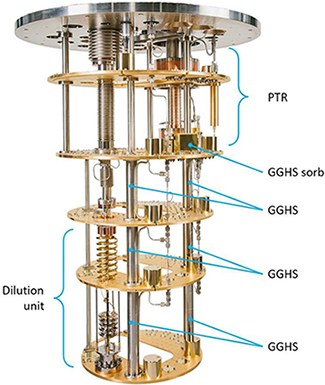
Proteox systems use thermally optimised gas gap heat switches (GGHS) that act as separable thermal links between the pulse tube cooler and the lower stages of the refrigerator.
These are not simple passive switches, rather thermal conduction is specifically controlled by adding or removing an 'exchange gas' between plates, using our patented method of heat switch formation [1].
Key design features include:
This combination gives Proteox systems a level of temperature control that is fundamentally hard for many competing systems to match.
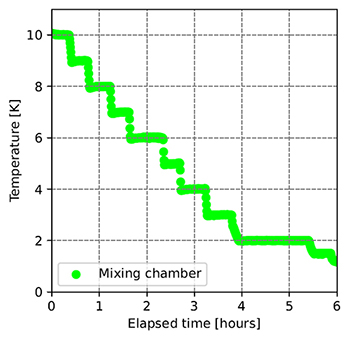
The temperature is stable to a few mK when controlling at 2 K.
One of the most important results demonstrated in the paper on GGHS for ultra-low temperature applications by Anthony Matthews et al. [2] is how the GGHS pre-cooling solution, when coupled with the remote sorption pump, does not compromise performance at higher temperatures. This is enabled by the novel method of installation laid out in our second patent [3].
Proteox gas gap heat switches achieve over 90% of the thermal conductance of a solid copper link at room temperature, this efficient thermal coupling at high temperatures dramatically improves system control, and maintains excellent performance well into the tens of Kelvin range.
This means the mixing chamber temperature can be actively controlled and stabilised up to 30 K, even when sweeping the magnetic field.
Many competitor systems rely on passive coupling or switches that unintentionally close at elevated temperatures, making true high temperature operation unstable or unreliable. Using GGHS technology the mixing chamber stage can be temperature controlled independently from the other stages of the system, as shown in the plot below:
In experimental demonstrations, Proteox systems equipped with GGHS technology were operated with:
Crucially, this was achieved without unintentionally re coupling the dilution unit to the pulse tube cooler, thanks to the remote sorption pump controlling the heat switches.
This capability allows researchers to:
The plot below shows data acquired on a Proteox dilution refrigerator system equipped with a 6:3:1.5 T vector-rotation magnet. The mixing chamber temperature was controlled at a range of elevated temperatures up to 30 K whilst the magnet is swept from zero field to the full 6 T.
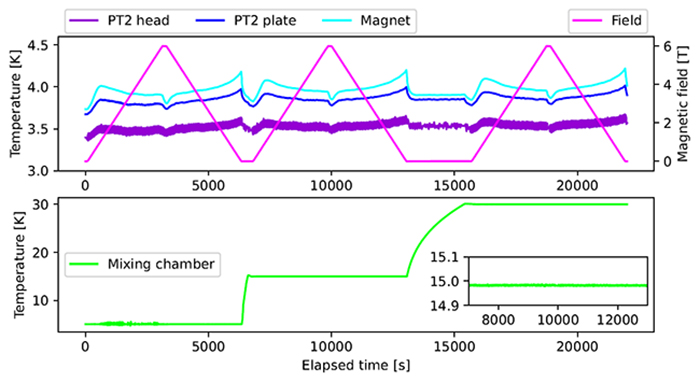
Note: The peaks in the magnet temperature at low fields occur due to the increase in AC-losses in this range.
High temperature flexibility does not come at the cost of low temperature performance.
When it is time to return to the millikelvin regime:
Once open at low temperature, the switches provide an operational switching ratio exceeding 100,000:1, ensuring heat leaks are fully compatible with sub 5 mK base temperatures.
Proteox systems provide:
Please also see our Application Note on Proteox High-Temperature Operation.
To find out more, contact your local representative or click here:
Contact Us
Copyright © 2026 Quantum Design Oxford