Earlier this year, we celebrated the first delivery of our open-architecture low temperature measurement system, the TeslatronPT Plus, to the BRIN-Q Research Center for Quantum Physics in Indonesia. This marks a proud and exciting milestone for Quantum Design Oxford and for quantum science in Southeast Asia. Located within Indonesia's National Research and Innovation Agency (BRIN), the center was established in 2022 to advance both fundamental quantum physics and the technologies that will underpin Indonesia's future innovation landscape.
The TeslatronPT Plus will play a central role in supporting research into quantum device development. It expands BRIN-Q's experimental capabilities not only as a fully-integrated, Cryofree® low temperature and high magnetic field system but also by offering adaptable, future-proof measurement through its open-architecture instrumentation and software environment. Bringing new experimental capability to physics labs around the world is a privilege that we enjoy through the global network of Quantum Design.
We sat down with Dr Mohammad Hamzah Fauzi, Head of the BRIN Research Center for Quantum Physics, to discuss how this installation fits into Indonesia’s broader quantum ambitions, what stood out to the team about the TeslatronPT Plus, and what they aim to achieve in the years ahead.
“The Indonesian government recognises the importance of investing heavily in research, including modernising research infrastructure and strengthening human capital as a foundation for Indonesia's long-term economic growth. Quantum science is a key pillar of the future global economy, and our efforts will contribute to building a stronger quantum ecosystem in Indonesia.
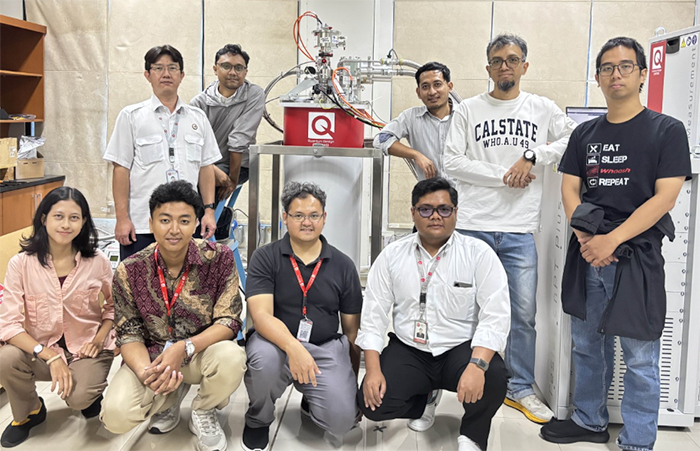
BRIN-Q group photo with their TeslatronPT Plus.
“We chose the TeslatronPT Plus because of its familiarity and ease of use. Having worked extensively with similar systems over the years, our team is already comfortable with its operation and measurement workflows, which significantly reduces the learning curve and allows us to focus on our experiments.
Its integration with the measurement setup stood out the most to us. The TeslatronPT Plus provides a seamless interface between the cryogenic platform and the measurement electronics, allowing us to efficiently control and synchronise experiments. This also meant we were able to begin measurements immediately after installation, significantly reducing setup time.
We were also very satisfied with the installation process. The team provided strong technical support and ensured that the system was set up smoothly.
“We chose Quantum Design Oxford not only for its reliability, but also for its support network in Southeast Asia. The company has a regional office in Singapore covering Indonesia and neighbouring countries, providing both sales and technical service support. This gives us confidence that the system will remain operational and well-maintained in the long term, which is critical for sustained experimental research.
“Our core research focuses on transport phenomena in two-dimensional materials and bulk single crystals with unconventional band structures. Our goal is to deepen the understanding of the interplay between strong electronic correlations, topology, and magnetism, and to explore novel quantum states. We believe that the systems we are studying could host exotic phenomena, ranging from topological states to strong electron correlations, that are not only fundamentally interesting but also highly relevant for future quantum technologies.
“We plan to leverage this setup not only to expand our experimental capabilities, such as adding a dilution refrigerator for ultra-low temperature measurements in the future, but also to nurture the next generation of students and researchers in quantum materials and low-temperature physics in Indonesia.
The TeslatronPT Plus provides an excellent platform for hands-on training in advanced experimental techniques, including cryogenics, precision transport measurements, and magnetic/spin resonance.
Looking ahead, we hope that within the next ten years, this effort will help build a stronger quantum research ecosystem in Indonesia.
To learn more about TeslatronPT Plus and how its open-architecture
approach to measurement hardware and software can transform
your low temperature experimental workflow:
About Mohammad Hamzah Fauzi
Mohammad Hamzah Fauzi is a senior researcher and the head of BRIN Research Center for Quantum Physics. Previously, Dr Fauzi was the group leader of the Quantum Devices & Technology research group. He obtained his doctoral degree from Tohoku University, Japan (2013), specialising in quantum transport and quantum devices.
Copyright © 2026 Quantum Design Oxford