
Dr Ben Bryant
Senior Development Engineer

Tessa Dale
Product Manager for
Quantum Technologies
If you are conducting experimental low temperature physics and using a dilution refrigerator to explore new quantum and electronic materials, you will most likely need to combine millikelvin temperatures with high magnetic field.
But how can you be confident that your superconducting magnet will operate reliably without upsetting the carefully balanced heat loads in a cryogen-free dilution fridge? And can you trust that it will consistently deliver that initial performance for years to come?
Quantum Design Oxford Proteox® dilution refrigerators deliver magnet integration confidence now and into the future – stable, reliable, and easy to control – because we provide the complete magnet and dilution fridge system from design to delivery. Ordering 14 Tesla for your Proteox means you receive, and keep, 14 Tesla.
A bold claim? Read on…
Quantum Design Oxford Proteox systems are designed, built, and tested in our Oxford, UK factory to ensure optimum system performance for hundreds of customers worldwide. Our Proteox cryogenic platforms and superconducting magnets are engineered by one team in one place, to deliver a fully integrated solution from the very start.
And this extends to our Oxford manufacturing team – one cohesive team who have shipped hundreds of systems that operate to their full specification for years and even decades.
So, when you order our standard Proteox 14 Tesla high field magnet for example, you can rely on receiving a magnet working at exactly that full 14 T specification – no compromises or excuses due to insufficient cooling, poor connectivity, or unforeseen interaction with the dilution fridge elements.
Have questions about your magnet? Being able to speak directly to us rather than third party vendors means you get first-hand expert advice on your entire system. And, because we control both the dilution refrigerator and magnet designs, you have confidence when you want to upgrade your magnet and take advantage of our continued magnet technology advances.
With a 65-year track record in high field magnets, we have developed world-leading proprietary design tools, IP, and manufacturing processes that underpin our NbTi, Nb3Sn and future high temperature superconductor (HTS) engineering. Let us give you some critical insights into the superconducting magnet and system engineering that delivers the magnet you ordered…
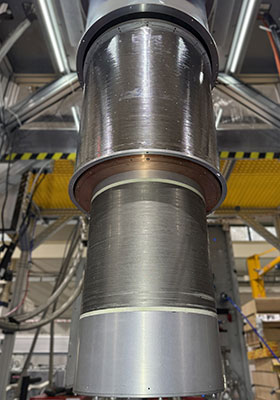
As a superconducting magnet ramps to field, and magnetic flux redistributes within the superconducting filaments of the wire, ac losses in the conductor generate heat – a dynamic heat load that varies during ramping and across the magnet coils, additional to the static heat loads of the system. Extracting this heat from the superconducting windings as efficiently as possible is essential for stable magnet performance.
Our Cryofree® magnets on Proteox systems use conductive "surround cooling" that closely replicates the isothermal cooling efficiency of liquid helium and provides a direct thermal pathway from the windings to the pulse tube refrigerator (PTR), allowing heat to be removed quickly and consistently. A Quantum Design Oxford magnet ramps to field quickly with no need to wait for system temperatures to stabilise.
For you as the user this means:
Every Quantum Design Oxford magnet is extensively modelled to guarantee it performs in every situation, from the lowest to the highest field. Our engineers simulate the heat loads to ensure that the system itself, the superconducting magnet, and any additional heat due to a customer's experimental wiring on the Proteox can be accommodated. In other words, your Proteox is modelled as one complete system!
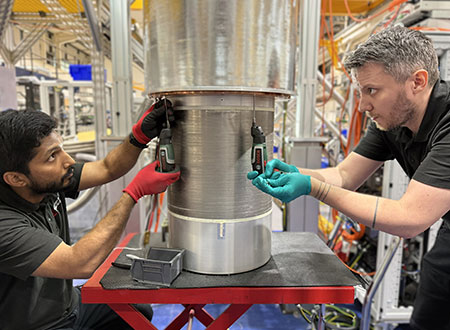
Electrical leads may sound trivial but applying current to a magnet whilst minimising heat load and ensuring long-term reliability is not. Our superconducting magnet current leads employ advances in high temperature superconductor technology to efficiently manage static and dynamic heat loads.
Quantum Design Oxford Cryofree magnets are wound from fine-filament superconducting wire – wire that contains a higher number of smaller diameter filaments than more conventional superconductors. This conductor design does two things: (1) reduces the inherent heating due to ac losses during field ramping (the dynamic heat load), and (2) significantly reduces "flux jumps" that can occur as flux redistributes during ramping – these statistically-driven events can disturb sensitive measurements.
Using fine-filament superconducting wire is not trivial, so our proprietary manufacturing processes have been developed for reliability and repeatability in each stage of magnet production.
Predictive modelling, fine-filament wire, and manufacturing control deliver:
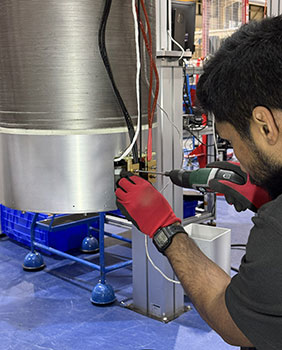
For experiments performed at a fixed magnetic field, in "persistent mode," a superconducting switch offers a major advantage. Once the magnet reaches its target field, the power supply can be fully de energised, removing even the slightest chance of electrical noise.
All Proteox standard solenoid magnets include a superconducting switch, supporting:
While your Quantum Design Oxford magnet will be quench-free in normal operation, unexpected scenarios e.g., power loss, can still occur and must be handled safely. Our quench-safe technology is a result of decades of detailed magnet analysis, testing and real-world experience, ensuring that both your magnet and Proteox cryogenic system remain protected.
When you receive a magnet, you will know that we have conducted extensive simulations and testing across all quench scenarios to guarantee:
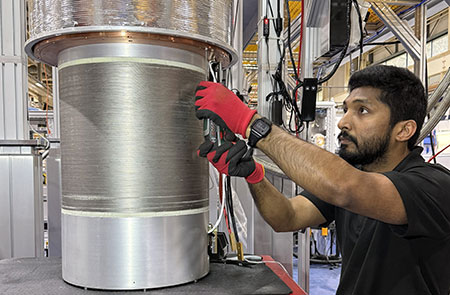
Magnet control is fully integrated into the Proteox system DECS control software, giving users a single, cohesive environment for managing their experiment.
Beyond control, the software delivers continuous system-level monitoring. If unexpected warming occurs – perhaps due to a loose connection or additional experimental wiring – DECS automatically limits or halts the field ramp.
DECS further applies intelligence to the magnet temperature to ensure the magnet always remains within its safe operating envelope, accounting for the critical field-temperature-current surface of the superconductors used. At field values where ac losses are low and a larger operating margin is available, DECS will allow the magnet to ramp at a higher temperature than at field values where ac losses are higher and the operating margin is reduced.
This intelligent feedback protects equipment, preserves measurement stability, and ensures users can conduct experiments with complete confidence that thermal conditions are being managed proactively.
With this full-system integration, Proteox users benefit from:
Look out for our upcoming blog and updates on DECS control software.
What does this all mean for you, as a purchaser and user of a Proteox system fitted with a superconducting magnet? By taking advantage of our magnet technology, total integration and decades of experience, you can have confidence in your Quantum Design Oxford system and stay focused on your research.
Let us help you choose your Proteox dilution refrigerator with a reliable high-field magnet solution –
contact your local representative or click here to find out more:
To find out more about the high cooling power at the 4 Kelvin (PT2) stage of Proteox systems, take a look at our previous blogs:
Copyright © 2026 Quantum Design Oxford