
Matt Martin
Managing Director and
Senior Director of Engineering

Dr John Burgoyne
Head of Product and Marketing
Scaling of Quantum Computing (QC) performance remains the defining challenge for superconducting qubit-based QC architectures. The challenges to be overcome lie in the integration of a larger number of physical qubits together with more capable cryogenic platforms. Growing superconducting qubit counts require ever larger cooling capacities delivered by dilution refrigerators that meet the required millikelvin operational temperatures.
The Quantum Design Oxford Proteox®QX features a 1 × 1.3 m sample workspace which, together with a highly configurable and modular architecture rises up to the challenge to offer a powerful dilution refrigerator platform for scaling. The patented ProteoxQX system, designed for extensibility, means multiple systems can be physically linked to form a single continuous vacuum space for multiple quantum processor units (QPUs). Cold stages from each system can also be thermally connected as appropriate to the implementation. These two innovations enable truly large-scale architecture for data centres.
These systems prove that interconnection between dilution refrigerators is no longer just a conceptual idea. Quantum Design Oxford has shipped multiple systems with a linked configuration fully demonstrated. The measured thermal behaviour of the combined system matches our modelled performance specification, confirming that the linking architecture works mechanically, cryogenically and ergonomically.
Whilst multiple units have shipped, two of these ProteoxQX core systems as shown here were linked and tested in our Tubney Woods, UK factory. These each had three dilution units, so the combined system contains six units fully automated with our DECS software operating them as a single system architecture.
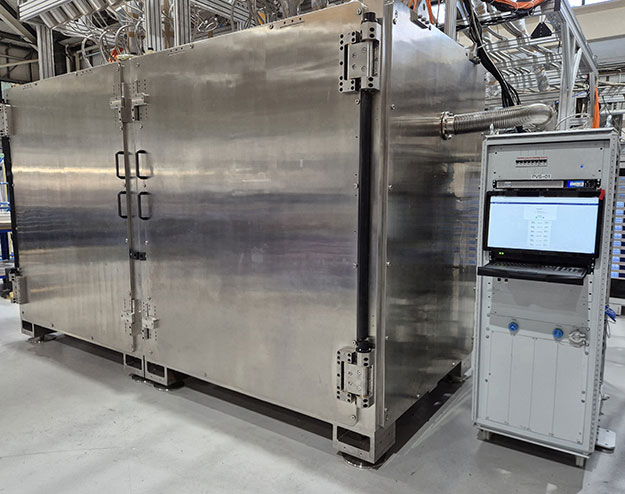
Figure 1: Two connected ProteoxQX units under system test, each with 6-Secondary-Insert configuration
The following performance has been demonstrated:
This result validates the extensible concept laid out in the US patent and proves that ProteoxQX can scale far beyond an individual fridge.
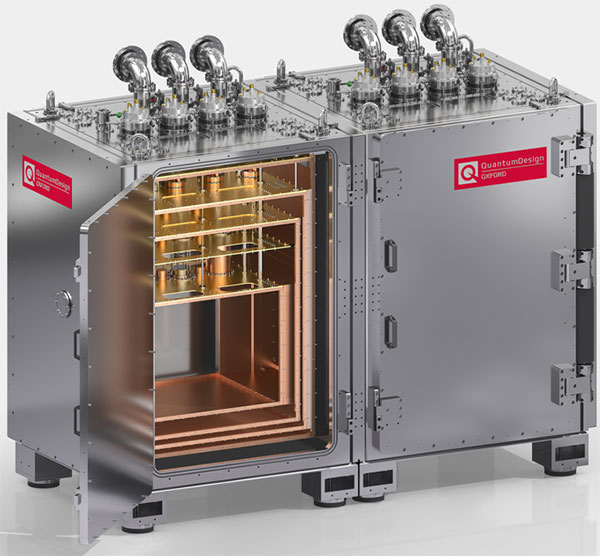
Figure 2: Two connected ProteoxQX units, each with 4-Secondary-Insert configuration (rendered model showing interior detail)
Beyond large-scale linking, ProteoxQX also supports powerful workflow agility through its side-loading Secondary Inserts, offering full development configurability. Each ProteoxQX can host four or six Inserts, all fully interchangeable with Quantum Design Oxford's ProteoxMX and LX systems, which host one and two Secondary Inserts respectively. This interchangeability allows teams to rapidly develop, pre-characterise, and iterate on smaller fridges with fast turnaround, then transfer an entire cabling solution intact into a ProteoxQX for deployment, and back again when further optimisation is needed.
With its validated large system scalability and modular Insert-based workflows, ProteoxQX stands as a uniquely proven, extensible foundation for next generation quantum computing at scale.
Copyright © 2026 Quantum Design Oxford