
Dr Tony Matthews
Measurement and Applications
Technology Manager
What really matters in a dilution refrigerator sample exchange mechanism? And why should you care when selecting your system? Let's talk about how the physics drives the design.
Join Dr Anthony Matthews, Measurement and Applications Technology Manager at Quantum Design Oxford, as he discusses the advantages of our market-leading bottom loading fast sample exchange system available across the Proteox Cryofree® dilution refrigerator range.
Dry cryogenic systems capable of reaching millikelvin temperatures have become a cornerstone of today's quantum and low temperature research. Whether using dilution refrigerators (DRs) to provide continuous cooling below 5 mK or adiabatic demagnetisation refrigerators (ADRs) at higher temperatures, researchers now routinely have access to sub 1 K environments without costly and inconvenient liquid cryogens.
But anyone who has run these systems knows: whilst steady state operation is efficient, getting there can be time consuming.
With a variety of sample exchange mechanisms available in the market to respond to the need for rapid sample changeover and cooldown, not all solutions offer meaningful cooling power at millikelvin experimental temperature, because they do not adequately address the thermal contact needed. Giving the user end-to-end high cooling power is a core aspect of Quantum Design Oxford Proteox® dilution refrigerators.
The Proteox bottom-loading puck sample exchange offers leading thermal performance and ease of use. It is the only solution that achieves < 12 mK at the sample position and can provide in excess of 150 µW of cooling power at 100 mK because the design focuses on maximum thermal contact. That means greater fidelity, repeatability and reproducibility of measurements – and less you need to worry about as an experimentalist.
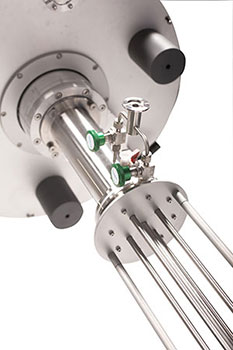
The first challenge lies in cooling everything from room temperature.
Most dry DR and ADR systems rely on a Pulse Tube Refrigerator (PTR) that provides 1-2 W of cooling power near 4 K during steady state operation – perfect for maintaining millikelvin temperatures, even with significant experimental wiring heat load.
Modern cryogenic systems are complex assemblies of nested radiation shields, thermal stages, and often a high-field superconducting magnet around the sample space. Cooling all of this hardware from 300 K to the PTR's operating point can require around 20 MJ of enthalpy removal. [1]
And although PTRs can deliver hundreds of watts of cooling power at ambient temperature [2], the significant enthalpy change involved means that initial cooldowns can take several days when equipped with high-field sample space magnets.
For labs needing rapid turnaround between experiments, this long initial cooldown is a real operational drag – even more so if a sample does not perform as expected and needs to be swapped out quickly.
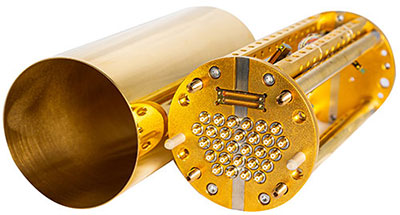
To solve the sample change issue, Quantum Design Oxford was the pioneer in developing a patented solution [3] that dramatically reduces experiment turnaround times by allowing sample exchange without thermally cycling the entire refrigerator. That sample exchange solution has been implemented on hundreds of our Proteox and previous-generation Triton Cryofree dilution refrigerators.
Instead of warming the whole system, only the sample region is brought up to a controlled exchange temperature. Everything else stays cold.
A straightforward loading operation takes only a few minutes to top or bottom load a sample before the software automated cooldown begins. This approach reduces turnaround time from days to hours – but it also introduces a tough additional engineering requirement: strong thermal contact when you need it, almost none when you don't.
Solving this thermal contact challenge is what sets the Quantum Design Oxford solution apart from others.
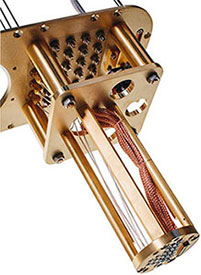
To quickly cool a newly inserted sample down to cryogenic temperatures, the sample stage must couple efficiently to the PTR. But during millikelvin operation, that link must be effectively switched off so the DR can take over.
Our patented heat switch technology [1, 4] provides exactly this:
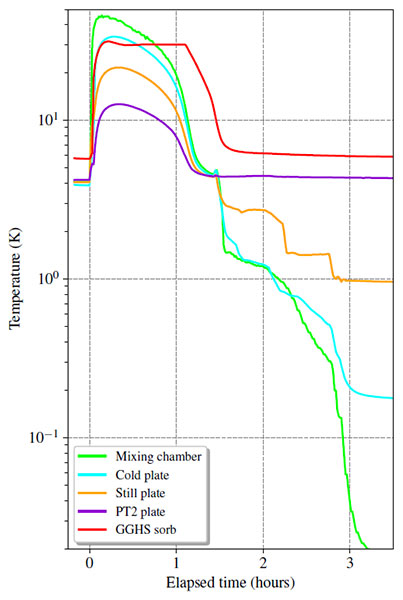
Fig. 1 shows system temperatures as a function of time after a sample is loaded (shown as elapsed time = 0).*
As a result, customers can achieve*:
These cooldown times compare exceptionally well with the multi day thermal cycles traditionally required.
(* Actual performance varies with configuration and sample mass.)
The final sample temperature can obviously not be lower than the base temperature of the refrigeration system – two factors control how closely the final sample temperature approaches this limit:
Heat leaks can arise due to black body radiation from higher temperature stages, which is why our systems use carefully designed moving radiation shields to block any such leaks from reaching the sample.
Attaining good thermal contact at millikelvin temperatures requires contact surfaces to be pressed together with high force [5]. Whilst simple loading mechanisms rely on “push-fit” contact, this limits their base temperature. Our Quantum Design Oxford sample exchange solution uses bolted connections. These ensure consistent, high thermal-conductance joints and allow operation at the lowest temperatures.
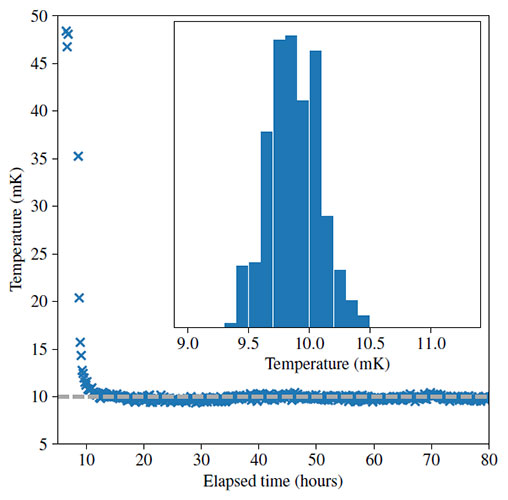
Fig. 2: Temperature performance with time at the sample position measured using a nuclear orientation thermometer.
Measurements using a nuclear orientation thermometer at the sample position confirmed that temperatures below 10 mK are achievable with our system.
And it's not just about hitting a low number – it's about maintaining it under real experimental conditions.
We've demonstrated hundreds of microwatts of cooling power at 100 mK at the sample position – comparable to the underlying refrigerator performance at these temperatures.
Many push-fit solutions struggle to offer meaningful cooling power at these temperatures. With our patented sample exchange platforms, researchers get:
Contact your local representative or click here to find out more:
Contact Us
Copyright © 2026 Quantum Design Oxford